



politics

Home politics
politics news within the country of Belize

62,363 unemployment relief applications received under Phase 2
0
62,363 unemployment relief applications received under phase 2 1

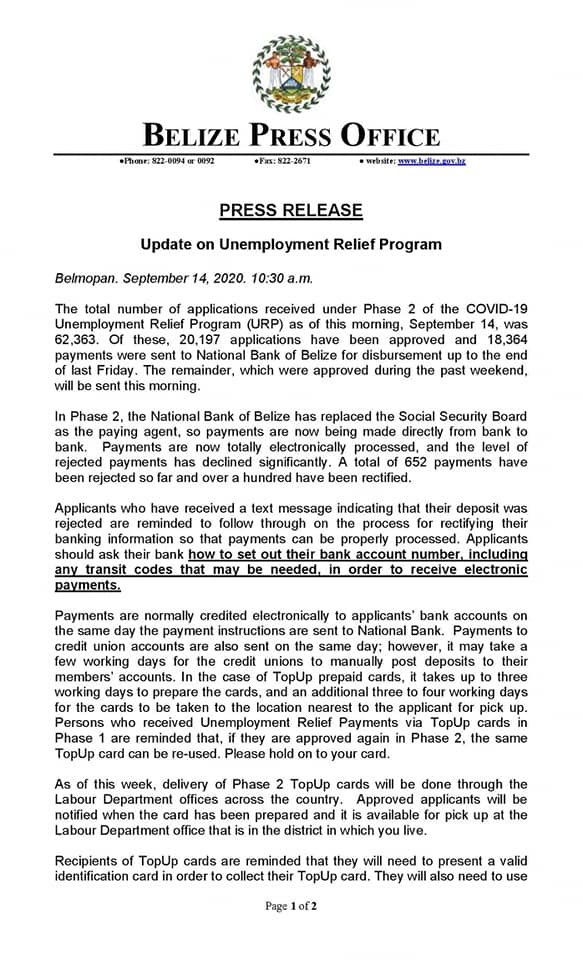
Update on Unemployment Relief Program

The total number of applications received under Phase 2 of the COVID-19 Unemployment Relief Program (URP) as of this morning, September 14, was 62,363. Of these, 20,197 applications have been approved and 18,364 payments were sent to National Bank of Belize for disbursement up to the end of last Friday. The remainder, which were approved during the past weekend, will be sent this morning.

In Phase 2, the National Bank of Belize has replaced the Social Security Board as the paying agent, so payments are now being made directly from bank to bank. Payments are now totally electronically processed, and the level of rejected payments has declined significantly. A total of 652 payments have been rejected so far and over a hundred have been rectified.

Applicants who have received a text message indicating that their deposit was rejected are reminded to follow through on the process for rectifying their banking information so that payments can be properly processed. Applicants should ask their bank how to set out their bank account number, including any transit codes that may be needed, in order to receive electronic payments.

Payments are normally credited electronically to applicants’ bank accounts on the same day the payment instructions are sent to National Bank. Payments to credit union accounts are also sent on the same day; however, it may take a few working days for the credit unions to manually post deposits to their members’ accounts. In the case of TopUp prepaid cards, it takes up to three working days to prepare the cards, and an additional three to four working days for the cards to be taken to the location nearest to the applicant for pick up. Persons who received Unemployment Relief Payments via TopUp cards in Phase 1 are reminded that, if they are approved again in Phase 2, the same TopUp card can be re-used. Please hold on to your card.

As of this week, delivery of Phase 2 TopUp cards will be done through the Labour Department offices across the country. Approved applicants will be notified when the card has been prepared and it is available for pick up at the Labour Department office that is in the district in which you live.

Recipients of TopUp cards are reminded that they will need to present a valid identification card in order to collect their TopUp card. They will also need to use the same telephone number they provided on their application to send a text message to Heritage Bank and receive their PIN to activate their TopUp card.

The public should note that there still remain about 1,000 TopUp cards at Social Security Board offices for persons approved under Phase 1 of URP that have not been picked up. Efforts are being made to reach each affected person individually so that they may pick up these cards from Social Security Offices by the end of this month. Only these last cards remaining from Phase 1 are at Social Security Board offices. No Phase 2 cards can be picked up from Social Security Board offices.

Over 11,000 applications have been excluded where applicants:

Are BOOST recipients; Receive Government or Social Security Pension; Applied as “long term unemployed” in Phase 1 – that category is not available in phase 2; Are below the age of 18; Appear in Social Security Board records as deceased persons; or Have identified an employer that says they do not, or have never worked at their business establishment.

Applicants are reminded that if they receive a message that they have been excluded and feel that this is an error, they may provide additional information by sending an email to [email protected] so that their application can be reviewed.

The public is also reminded that Government of Belize’s covid19.bz website allows all applicants to check on the status of their application by following this link: https://payment.covid19.gov.bz/paymentstatus. Applicants are invited to use this platform to check the status of their application at any time.

Rt.Hon Said Musa Steps Down

0
Said Musa Steps Down fomr PUP politics

PUP Fort George Area Rep Rt.Hon.Said Musa has stepped down from electoral national politics.Due to factors of his health and well-being,the minister issued a statement that he will immediately step aside for new potential candidates to run for Fort George Division.

Follow PUP on their designated site

Statement by Dr. Senator Hon. Carla Barnett at the UN Meeting

0
DR CARLA BARNETT Challenges UNITED NATIONS MEETINGS

PRESS RELEASE

Statement by Dr. Senator Hon. Carla Barnett at the United Nation’s Meeting of the Ministers of Finance:

Financing the 2030 Agenda for Sustainable Development

in the Era of COVID-19 and Beyond

September 8, 2020.

Ladies and gentlemen, good day.

Belize wishes to commend Jamaica and Canada for attempting this much-needed initiative to coordinate a global response to the catastrophic economic and financial impact of COVID-19. The actions we take now can help to ameliorate the impact of this catastrophe. But if we do nothing, or if our actions do not frontally address the economic consequences at their root, the economic and social impacts for people on the ground will continue to be tremendously negative.

Suffering is manifold worldwide. For the first time since 1998 the World Bank projects that the global extreme poverty rate will increase, effectively eroding progress that has been made. Far from being the great equalizer, COVID-19 is the magnifier of inequality. This is particularly hard felt in countries such as my own.

Belize, a tourism dependent, export-oriented country, suffered an abrupt economic shock when travel and tourism ceased in March. At least 20,000 workers in tourism alone lost their jobs in one go at the height of the tourist season; and agriculture immediately felt the impact as well because that market for fresh produce immediately disappeared. Twenty thousand in one sector may not sound like a lot, but for a small economy with a relatively small population, unemployment doubled from 10% to at least 20%.

The height of the pandemic in Belize coincided with the start of a predictably volatile Atlantic hurricane season. Over the past few years, Belize has been experiencing increasingly erratic extremes of drought and floods. Five days ago, Hurricane Nana bore down on southern Belize and severely damaged our export and domestic food crops, and damage assessment is currently underway. Before this hurricane, the IMF and World Bank were predicting GDP contraction for Belize in the region of 20% to 25%. To that we now have to add the impact of hurricane.

This is a reality that science predicts we are destined to suffer again and again. While we do not contribute to the changes that are increasing these climate events in both their regularity and intensity, we do carry the disproportionate burden of their impacts and consequential cost. SIDS are likely to experience GDP contraction in 2020 at three times the global rate as a result of the pandemic alone. Factoring for climate impacts, that contraction becomes all the more unpredictable and dire.

I challenge you all to step in our shoes, as uncomfortable as they are, and look at each of the policy options you have placed before us. Examine, when applied to SIDS, like Belize and the rest of the Caribbean in particular, that are facing the twinned crises of a pandemic and climate change, how these will expand our access to finance. Tell us how these will assist us to avoid being strangled by already high debt – which has to be compounding as we borrow to meet the added costs of meeting healthcare needs and minimal social safety nets for the unemployed and vulnerable populations. Demonstrate how these policy options will improve our capacity to stay on track to achieve our sustainable development goals and our ambitious climate targets by keeping our economies and our people alive.

In our assessment, these policy options give us little hope at this stage. Six months into the COVID-19 pandemic, our budgets literally have collapsed and there is no really predictable timeline for an economic rebound. Yet, the proposed policy options would have us, in the short-term carry an additional burden of even greater debt, or worse, enter into structural adjustment programs, when our economies have already been adjusted downward, our public sector revenues have collapsed while health related and social safety net expenditures have had to increase. In the medium-term we are directed to a variety of purported financial solutions, but these rely on goodwill and the financial backing of others who may well be too pressed themselves.

COVID-19 has exposed the inefficiencies of the global financial and economic systems in addressing global economic contraction and these options today suggest an unabashed affirmation of business as usual. They can be crudely narrowed to a choice of upholding markets at the expense of the public good.

The options we set forth now will be definitive of our people’s future. The options that will enable Belize and other SIDS to recover and do better, must include: access to liquidity for all SIDS on grant and concessional terms; debt workouts inclusive of private creditors; debt for development and debt for climate swaps; and recovery aligned with the Paris Agreement. To sidestep this imperative would be a disservice to all our future generations. What we need more than anything is the action to support our words or small island developing States will be tip toeing under the feet of the Colossus to find ourselves dishonorable graves.

Thank you.